AI avatar stylist
A conversational AI that restyles your 3D avatar from a single sentence. Shipped 0 → 1 across Family of Apps and Horizon mobile.
A conversational AI that restyles your 3D avatar from a single sentence. Shipped 0 → 1 across Family of Apps and Horizon mobile.
1B+ avatars created across Family of Apps and Horizon. The editor is the hub — where identity gets built, refined, and re-styled for every social surface users show up on.
Two problems, one opportunity.
Not as a roadmap item. It began as a fun exploration with my engineering partner — the two of us building a working prototype off the side of our desks, on the live model rather than in a clickthrough. That prototype got traction with leadership, and the workstream formed around it.

The model never touches geometry. It reads the avatar’s current configuration and the request, reasons per category about what a look actually implies, and returns item IDs from the catalogue that already exists. “Beach vacation” leaves the face alone, swaps the sweater for a crop top, jeans for shorts, sneakers for sandals. Constraining it to a config in and a config out is what makes the results consistent enough to ship.

End-to-end. From the first whiteboard to public launch at scale. I set the vision, defined the staged rollout, and ran the multidisciplinary team that built every phase.
Two failure modes from early testing: users expecting magic, and users refusing to engage. Both kill the product. Fix: an honest NUX plus 100+ curated starter prompts. Capability taught by example, not by instruction manual.
An empty text field is the hardest surface in UX. Built a contextual suggestion system — starter prompts with personality, follow-ups that build on the user's last move. Creative momentum without telling people what to make.

One AI output reads as take-it-or-leave-it. Built an "ingredients grid" instead — multiple outputs per prompt, mix and match between rounds. Users became co-creators rather than judges of one machine guess.
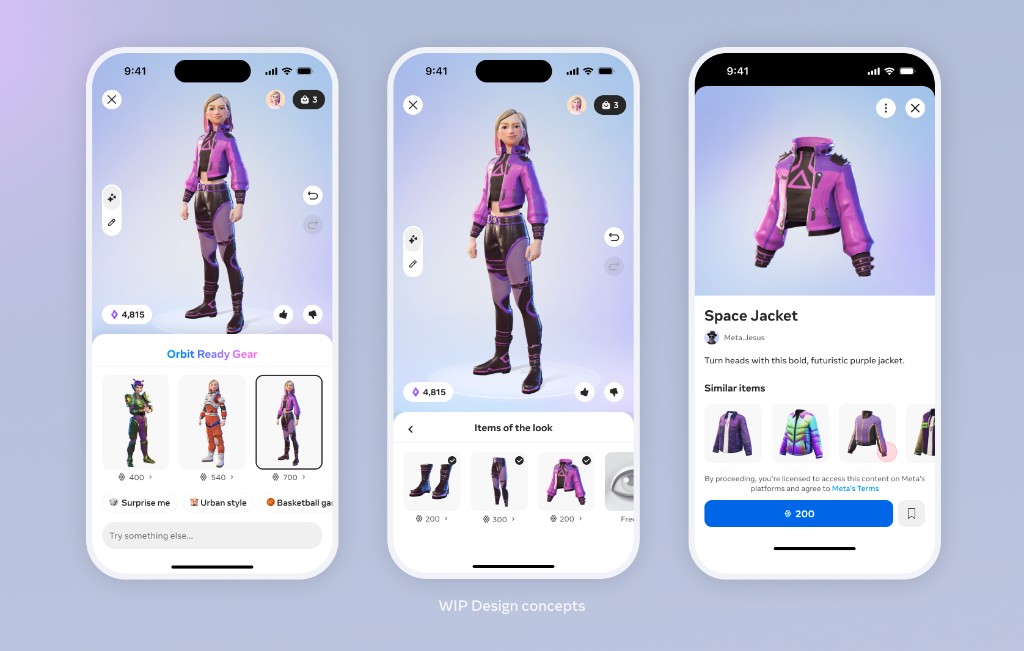
Users wanted AI magic and fine-grained control. Designed a seamless mode-switch: AI restyles the silhouette, the manual editor tunes the details. Start with either, end with both.
Trust isn't built by what works — it's built by how the product handles what doesn't. About half of study participants arrived expecting full generative magic, and the system couldn't deliver all of it. Satisfaction held up after use anyway, because failure was treated as a first-class state instead of an edge case.
Proactive feedback — toasts and inline messages flag the moment a request isn't supported, so users aren't left guessing or repeating the same failed prompt. Seamless fallbacks — when AI can't deliver, the route to manual editing or an alternative flow is one tap away. No dead ends.

Style with AI debuted on stage at the Meta Connect 2024 developer keynote — the public commitment that locked in the launch.
New registrations to the Meta mobile gaming platform — 3rd-largest growth contributor across the entire product.
More spent on paid content than in the traditional editor.
Ease-of-use scores beat platform benchmarks at launch.
Retention beat platform benchmarks — users came back.
As featured in