Avatars editor
Parametric editing for a next-gen avatar style — face, body, color systems — across mobile and VR. Validated across five rounds of UXR.
Parametric editing for a next-gen avatar style — face, body, color systems — across mobile and VR. Validated across five rounds of UXR.
1B+ avatars created. A new avatar style was about to launch — but the existing editor only let users pick from presets. To match the visual jump on the new style, the editor had to grow up too: from preset-picking to real parametric control.
Led the design of the parametric editor for the new avatar style. The UX that lets users shape faces and bodies with precision — not pick from a menu.
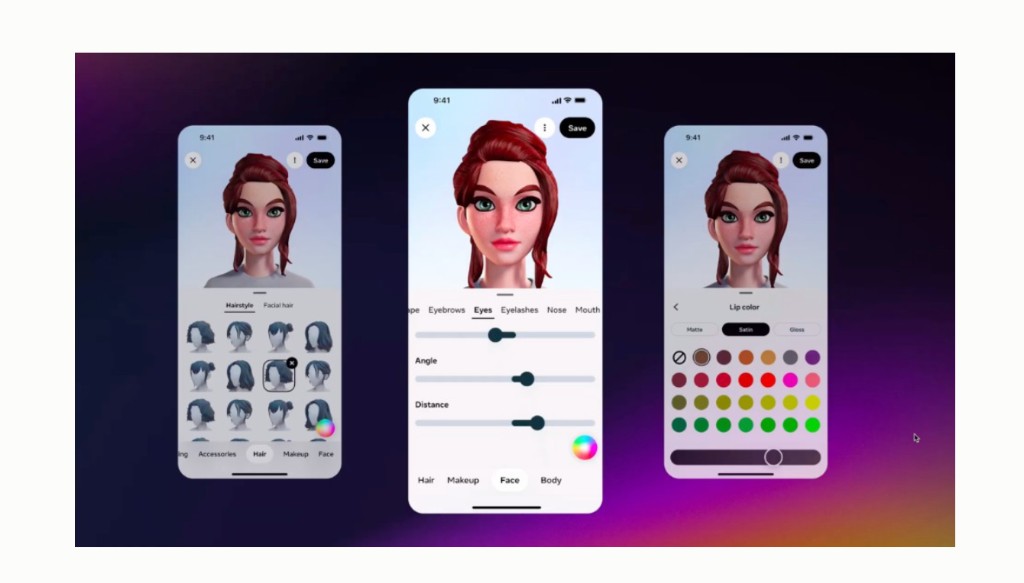
This was never only a mobile feature. The same identity system had to hold on a phone and inside VR — the editor as a panel floating at arm’s length, driven by gaze and controller instead of a thumb. A control that reads as a tidy grid at six inches becomes a reach target in a room, so each pattern had to be designed once and survive both.

Hair, face, torso, arms, legs, feet — each with its own shapes, colours, textures and accessories, and each of those with states, modifiers and edge cases. Drawn out in full, the system runs to hundreds of screens. Depth was never the hard part. The hard part is that depth is overwhelming the moment you show all of it at once, and this editor had to stay something people would play with.
A system this size gets designed at two altitudes at once. I mapped the whole customization surface — what belongs to hair against face against torso, which attributes want a grid, which a slider, which a colour bar — then took that structure down into screens, where the edge cases push back and send you up to revise it again. Getting the taxonomy right is what lets the interface stay quiet: a few clear choices at a time, everything else one level down until it’s asked for.


Shipped the next-gen avatar style launch across mobile and VR with full parametric editing.
The avatar-creation completion baseline — cleared after launch.
Expanded representation — inclusive body, face, and complexion ranges.
Became the canvas for the next wave of AI editing — Style with AI restyles against this parametric system.
As featured in